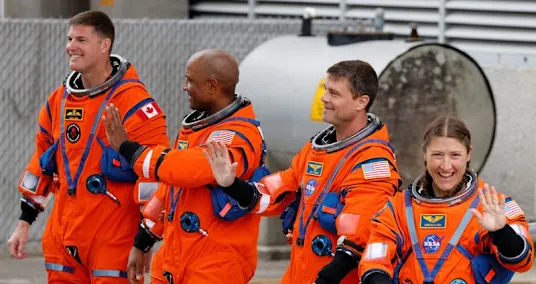
April 1 (Reuters) - All three NASA astronauts on the Artemis II lunar mission are veterans of Earth-orbit science expeditions to the International Space Station, while the lone Canadian joining them on a voyage around the moon and back is a spaceflight rookie.
Here are some highlights from the careers of mission commander Reid Wiseman, pilot Victor Glover and mission specialist Christina Koch, all U.S. astronauts, and Canadian astronaut Jeremy Hansen, also a mission specialist.
MISSION COMMANDER REID WISEMAN
Wiseman, 50, logged 165 days aboard the International Space Station during a 2014 mission, flying to the orbiting platform aboard a Russian Soyuz spacecraft. A former U.S. Navy test pilot, he later served as NASA's chief astronaut before being selected to command Artemis II.
PILOT VICTOR GLOVER
Glover, 49, spent 168 days in orbit beginning in 2020 as pilot of NASA's Crew-1 flight, the first full-fledged ISS mission using SpaceX's Crew Dragon capsule to carry astronauts to the space station. Before joining NASA, he flew more than 40 aircraft during a U.S. Navy career that included combat deployments and test-pilot duties. A veteran of four spacewalks, he is the first Black astronaut ever to be sent on a lunar mission.
MISSION SPECIALIST CHRISTINA KOCH
Koch, 47, set a record in 2019 for the longest continuous spaceflight by a woman, spending 328 days aboard the ISS, and was part of NASA's first three all-female spacewalks. Trained as an electrical engineer and physicist, she previously worked as a NASA engineer and carried out extended research expeditions in Antarctica. She is the first woman to fly on a moon-bound mission.
MISSION SPECIALIST JEREMY HANSEN
Hansen, 50, a Royal Canadian Air Force colonel, is the first Canadian, and first non-U.S. citizen, sent on a lunar mission even as he makes his own first spaceflight. He was selected for Canada's astronaut corps in 2009, and his seat aboard Artemis II reflects a long-standing U.S.–Canadian partnership in human spaceflight, including Canada's contributions to robotics used aboard the ISS.
(Compiled by Joey Roulette in Cape Canaveral, Florida and Steve Gorman in Los Angeles; Editing by Jamie Freed)
LATEST POSTS
- 1
 The next frontier in space is closer than you think – welcome to the world of very low Earth orbit satellites
 - 2Why don’t humans have hair all over their bodies? A biologist explains our lack of fur
- 3Horror and fear in West Bank as Israel approves hanging Palestinians convicted of murdering Israelis
- 4If evolution is real, then why isn’t it happening now? An anthropologist explains that humans actually are still evolving
- 57 Well known Vacation spots In The US





- UK to hold fresh pork, other affected Spanish products at border amid African swine fever outbreak
- Flourishing as a Charitable Pioneer: Individual Encounters in Generosity
- Director Emerald Fennell explains why "Wuthering Heights" has quotation marks around the title
- New science points to 4 distinct types of autism
- James Webb Space Telescope discovers a lemon-shaped exoplanet unlike anything seen before: 'What the heck is this?'
- Songbirds swap colorful plumage genes across species lines among their evolutionary neighbors
- What to know about Jack Dorsey's new Vine revival, DiVine
- Extravagance SUVs for Seniors: Solace, Innovation, and Security
- Make your choice for a definitive Christmas getaway destination!


